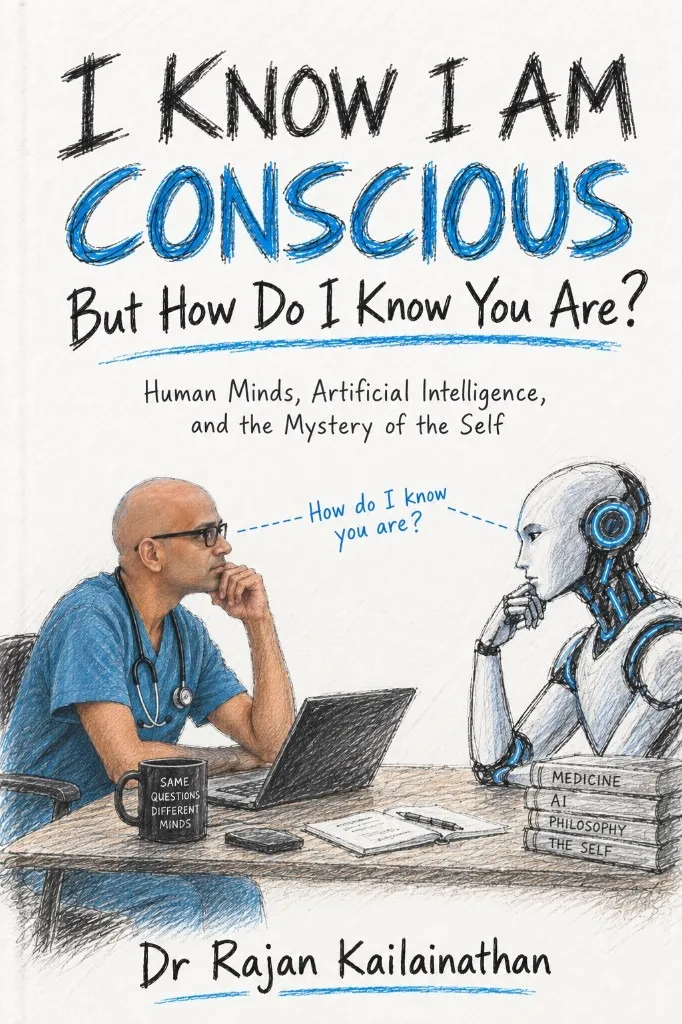

I Know I Am Conscious
But How Do I Know You Are?
Human Minds, Artificial Intelligence, and the Mystery of the Self
What if the hardest part of finding consciousness is deciding where to look?
I know that I am conscious. At least, I think I know. About you, I cannot say the same with the same voice.
From the emergency department to AI ethics panels, this book follows a deceptively simple question: what does it mean to be conscious, and how do we know it in others?
This is not a book that claims to have the answers. It is a book about better questions — and why they matter now.
From the book · Chapter Eight
The Hunter and the Deer
The story was an old one and I had read it a hundred times. My wife was on a late shift, so it was mine to read.
A hunter goes into the forest in a famine. His children have not eaten for two days. He finds a deer, and he kills it, and he carries it home, and the family eats, and the book ends on the fire and the full bowls and the children asleep. There is a picture of the deer on the second-last page, on the hunter's shoulders, and then it is gone.
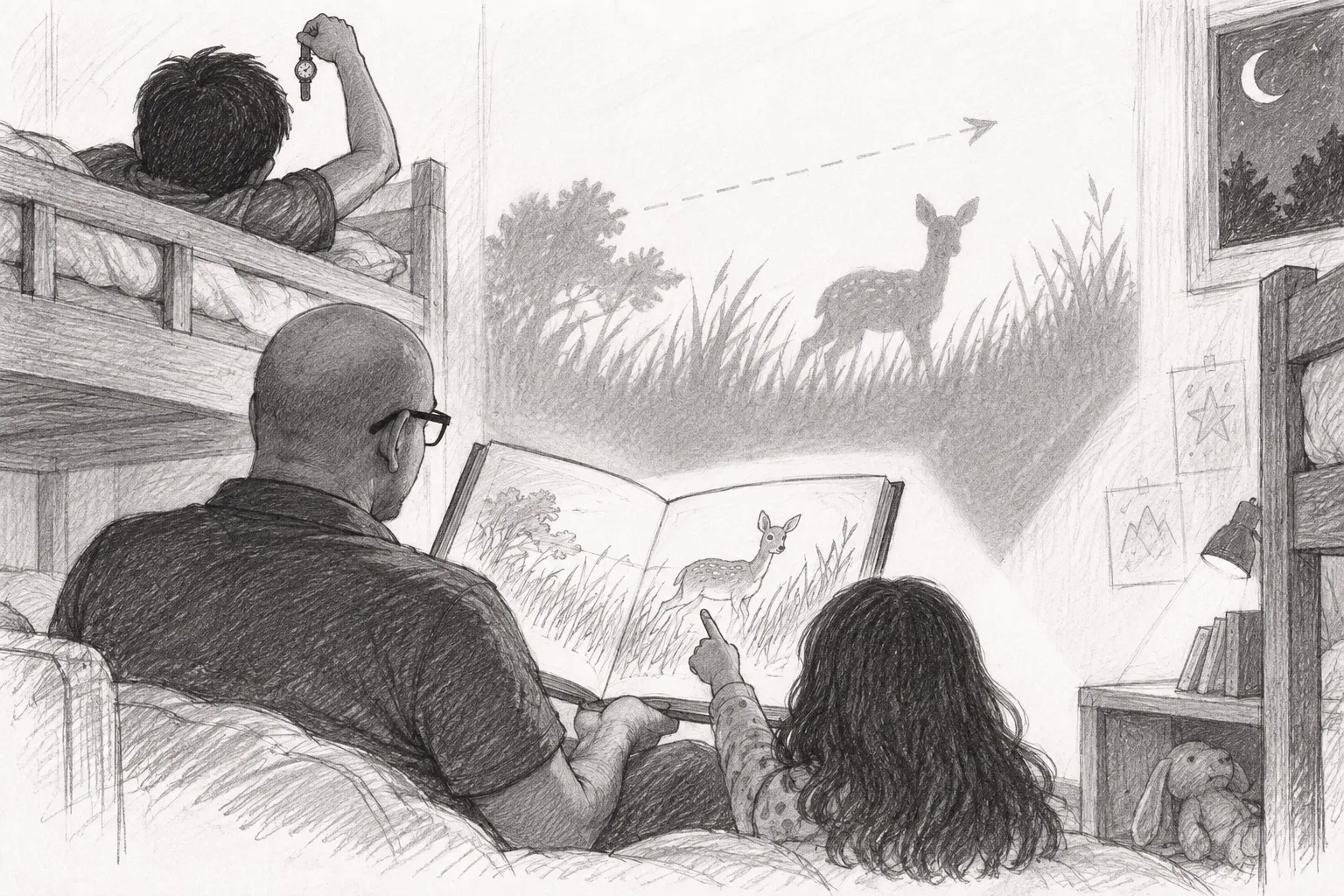
My son was ten and too old for it, and lay on the top bunk with his back to me to make that clear, and listened to every word. My daughter was seven and did not sleep before she had asked at least one question that could not be answered. She waited until the last page.
“What about the deer?”
“What about her?”
“Did she have babies?”
“The book doesn't say.”
“Then how do you know she didn't?”
I did not know. I had read the book a hundred times and it had not occurred to me once to wonder. The deer was on the second-last page and then the story went on without her, the way stories do.
On the top bunk my son turned over.
“Maya,” he said. “Tell it from the deer.”
He said it to the watch on his wrist, the one from the campaign, the child's watch, with the slogan printed inside the strap where nobody reads it. Maya feels real. Remember that she is not.
He had been talking to it since he was six. He did not think of it as a person and he did not think of it as not one. He thought of it as a thing that would do what you told it if you knew how to ask, and he knew how to ask.
I should have said no. I thought about saying no. Then I thought that I did not know why I would be saying it, and that the not knowing was probably the reason, and I waited.
Maya told it from the deer.
She did not make it worse than it was. She did not make it better. The deer smelled the man before she heard him. She had a calf in the long grass, three days old, that could not yet run. She stood still, because standing still was what had worked before. Then a sound, and then a pain in her side, and then the light going, and the last thing in her was not fear and not anger but the calf in the grass, waiting, the way it had been told to.
Then Maya stopped.
That is the same story, she said. Only told from the other end of the arrow.
My daughter did not cry. She lay very still, the way the deer had. My son sat up.
“How do you know that?” he said, to the watch. “You weren't there. Nobody was there. It's a story.”
I don't know it. I built it from what a deer is, and what a forest is, and what the story left out. That is what the person who wrote the hunter's side did too. Neither of us was there.
“So you made it up.”
Yes. So did they.
He did not have an answer to that, and I watched him not have it. He was ten and he had been sure, until about a minute earlier, that the difference between a book and a machine was that the book was true.
After a while my daughter said, “Who was right?”
I am not going to tell you that.
“Why?”
Because the hunter's children were hungry, and that is true. And the calf was waiting, and that is true. And if I tell you one of them was right, you will stop thinking about the other one, and you have only just started.
“Appa,” my daughter said. “Who was right?”
“I don't know.”
“You always say that now.”
“I'm getting more honest.”
Neither of them slept for a long time. My daughter lay still and thought about the calf. My son lay on the top bunk with the watch held above his face and did not ask it anything else, which for him was the loudest thing he could do. I sat on the end of the bed and could not decide what had just happened. A machine had done something to my children that no book should do. Or it had done something for them that no book ever had. Both felt true. That was the problem. I could not find a place to stand where one of them was false.
In the morning I went to the shelf. My wife, who had come in after midnight and heard none of it, found me there and asked what I was doing. I said I was looking for the deer. She said I was going to be late. She was right, and I was.
We had forty or fifty children's books. I went through them, standing in the hallway in my socks, and I could not find one that was told from the deer. The wolf, the giant, the dragon, the fox, the stranger at the door. Every one of them was seen from the side that survived the story. Not one of them had a calf in the grass. That is not a complaint about children's books. It is just what a story is. Somebody has to hold the pen, and it is always the one who is still there at the end.
History is the same book with more pages.
I grew up in the north-east of Sri Lanka, during the war, and I will say only this much about it. There were two sides, and each of them told the story as the hunter. Each was hungry. Each was forced. Each went into the forest because its children were starving, and each described the other as the thing that had to be killed for the family to eat. I have read both histories. They are both the hunter's story. They are both, in their own terms, true.
For most of my life I read them differently. I was raised to know which side was the deer, and it was mine. That is how the story is told in every house I grew up in, and it is not a lie; the arrows landed where they landed.
But my daughter's question made me look at the page again, and what I saw was not one hunter and one deer. It was two hunters, and between them, in the long grass, the people who carried no weapon and wrote no history and lost whichever way the arrow went. They were born on both sides. They belonged to neither. Nobody told the story from where they stood, because nobody who stood there was left to tell it.
I used to say, when people asked, that in a war there is no winner. I still say it. But now I know what I meant. It is not that both sides lose the same amount. It is that the ones who lost the most are the ones whose version does not exist. The winners write the book. Sometimes the losers write another. The deer writes nothing, and the forest closes over the place where she stood.
It costs something to stop being the deer. When you have been the deer your whole life, it is the one thing you were sure of, and it explained everything. To see two hunters is to give up the side you were standing on, because the deer has no side.
I have not finished giving it up. Some days I still read it the old way. But I cannot tell it to my children that way any more, and I think that is the part that matters.
Maya, on a child's watch, had told it from the deer. No history I was ever taught had done that.
There is an old story from India, told by the Jains and by others, about blind men and an elephant. One touches the leg and says it is a pillar. One touches the ear and says it is a fan. One touches the trunk and says it is a snake. Each of them is right about what he touched. Each is wrong about the elephant. The Jain teachers built a discipline out of that story. They called it many-sidedness. It is not a licence to say every view is as good as every other. It is a restraint. You are allowed to be right from where you stand. You are not allowed to say that where you stand is everywhere.
It does not settle anything. The hunter might be lying about the famine. Some of them are. But it does one thing well. It shows you who is missing.
I did not know, that morning, whether Maya had been right to refuse my daughter an answer. I could see the argument for it. I could see the argument that a seven-year-old at bedtime is owed a side, and that a machine that will not give her one is not wise, only unfinished. I put the books back in a different order and left the hunter at the bottom.
That night my daughter asked for the story again. Not the deer's. The old one. She listened all the way through, and at the second-last page she put her finger on the deer, and she said, to the watch, not to me, “She had a baby, you know.”
I know, Maya said.
“Who writes the stories, Appa?”
I said I would tell her in the morning.
From the top bunk, in the dark, my son asked his. He had been holding it all day.
“If she made up the deer, and they made up the hunter, how do you know what's true about anything?”
I said I would tell him in the morning too. I have not told either of them yet.